

OmniStudio is the layer nothing else verifies. Salesforce’s Code Analyzer excludes it; deploy validation doesn’t check that a referenced DataRaptor or Integration Procedure actually exists; deployment tools move it but don’t verify it. kipmox treats OmniStudio as a first-class part of your dependency graph.
The problem: OmniStudio references are strings, not code
In Apex, calling a method that doesn’t exist won’t compile — the deploy fails and you find out immediately. References are typed and checked. In OmniStudio, references are just strings inside JSON. An OmniScript step calls a DataRaptor by bundle name ("bundle": "SavePolicyData"); an Integration Procedure calls another IP by procedure key; a FlexCard points at an IP by ipMethod. Nothing validates those strings at deploy time. So this happens constantly:
- A developer renames or deletes a DataRaptor (or fat-fingers a procedure key).
- A component elsewhere still references the old name.
- It deploys clean — green checkmark, ships to production.
- A user runs that OmniScript, hits that step, and gets a silent runtime error — in production.
What kipmox sees
kipmox parses the real, VBT-expanded DataPack format (a folder per component) and is namespace-agnostic (vlocity_cmt__, vlocity_ins__, or the %vlocity_namespace%__ token). It scans your whole project — including an untracked vlocity/ directory — and links every component into one graph:
Because a DataRaptor’s field maps onto the same field node your Apex uses, a field change blasts through both Apex and OmniStudio in a single graph — no separate engine.
Change impact: a field change through the Omni chain
Ask your agent “what breaks if I delete / rename / make requiredAccount.Status__c?” and analyze_change_impact walks the field into the OmniStudio chain:
field → DataRaptor → Integration Procedure → OmniScript → FlexCard
The reference at each hop is a different string — the field API name, then the DataRaptor’s output alias, then the IP’s procedure key — spread across separate files. A text search for Status__c stops at the DataRaptor; only the dependency graph follows it to the OmniScript.
All six change types are covered — deleted, renamed, required, picklist-value-removed, type-changed, length-shortened — and impacted components are classified by:
- Write path — components that write the value (through a Load DataRaptor). If the value is removed or the field deleted, these fail at runtime.
- Read path — components that only read / display the value. They won’t error, but logic that branches on the value may silently go stale.
The alias trap — why a search can’t do this. A DataRaptor maps
Legacy_Code__c to an output alias LegacyCode; an OmniScript consumes it as %…:LegacyCode%. The field name, the DataRaptor name, the IP’s procedure key, and the alias are four different strings in four different files — none of them the field’s API name. A text search for Legacy_Code__c finds the DataRaptor mapping and stops. Only the dependency graph connects the field all the way to the OmniScript.Where-used: what depends on an OmniStudio component
Target a DataRaptor, Integration Procedure, OmniScript, FlexCard — or a field — by name withanalyze_impact to get its blast radius:
- downstream — everything that would break if you change it (the IPs and OmniScripts that run a DataRaptor, multi-hop through IP → IP chains).
- upstream — everything it depends on.
- cross-object precise — a change to
Policy__c.Amount__cdoes not drag inPayment__c.Amount__c, even though they share a field name. The graph is keyed by object + field; a search isn’t.
Reference integrity: “do all my OmniStudio references resolve?”
verify_omni_references scans every active OmniScript, Integration Procedure, and FlexCard and reports each DataRaptor / IP / Apex Remote-Action call whose target does not exist in the project — the silent-runtime breaks described above.
1
You rename or delete a component
Say you rename the DataRaptor
AccountExtract, but three Integration Procedures still call it by its old name.2
Your agent runs verify_omni_references
kipmox scans the active OmniStudio layer and finds every unresolved reference — deterministically, in one call.
3
You fix it before it ships
It reports all three broken IPs (not just the one you remembered), with the file and the likely fix — before the change deploys clean and fails in production.
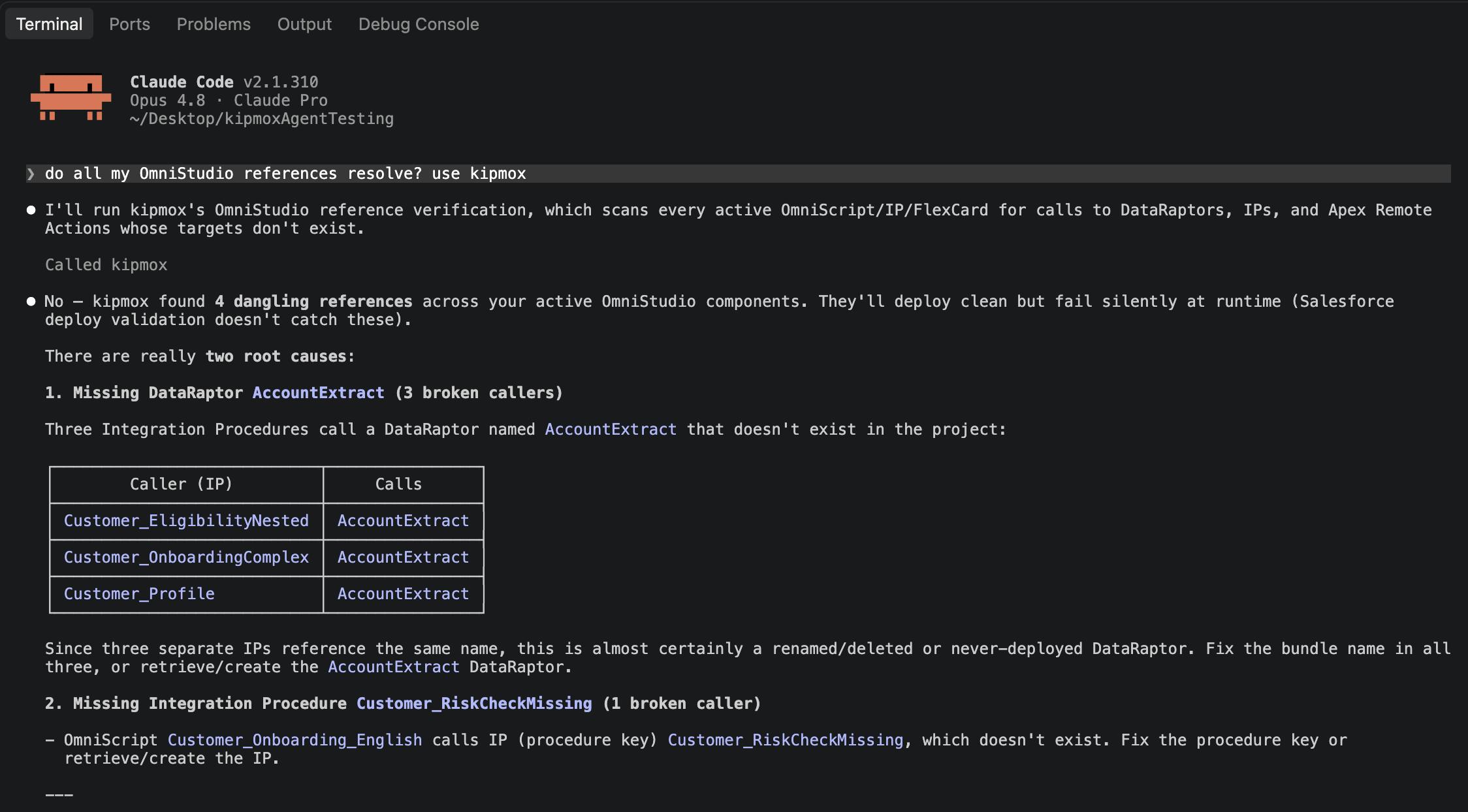
verify_omni_references in an AI coding agent: one renamed DataRaptor silently broke three Integration Procedures — all would have deployed clean.
verify_omni_references drops straight into a CI / PR gate or a pre-commit hook — a dangling DataRaptor reference turns the PR red before it can merge. A Salesforce deploy validation can’t be extended to do that; a kipmox check can.
What kipmox doesn’t check yet
kipmox is honest about its blind spots, and OmniStudio is no exception:- Field-level references (a DataRaptor mapping a field that doesn’t exist) — resolving these from local files alone is noisy (standard fields have no metadata; custom fields may live in the org but not be retrieved). This needs an org-connected map and is reported as a coverage note today, not guessed at.
- Dynamic
%merge%keys — a procedure key resolved from data at runtime (%NotificationProcedure%) can’t be verified statically. - Inactive components and references inside them — excluded, because they don’t run.
- Platform/standard OmniStudio metadata (
OmniProcess,OmniUiCard) — current support is for packaged Vlocity DataPacks.
OmniStudio support is local-first: it reads the DataPacks in your project. For a team with the full Omni layer in source control, that’s complete. A project with piecemeal-retrieved OmniStudio may under-report blast radius — connect your org for complete coverage (coming). The results always state their coverage so you know where a human check is still needed.
Tools
analyze_change_impact, analyze_impact, verify_omni_references
Quickstart
Sign in, add the MCP server, run your first analysis